What Is RFID Technology and Why Is It Increasingly Used for Access Control?
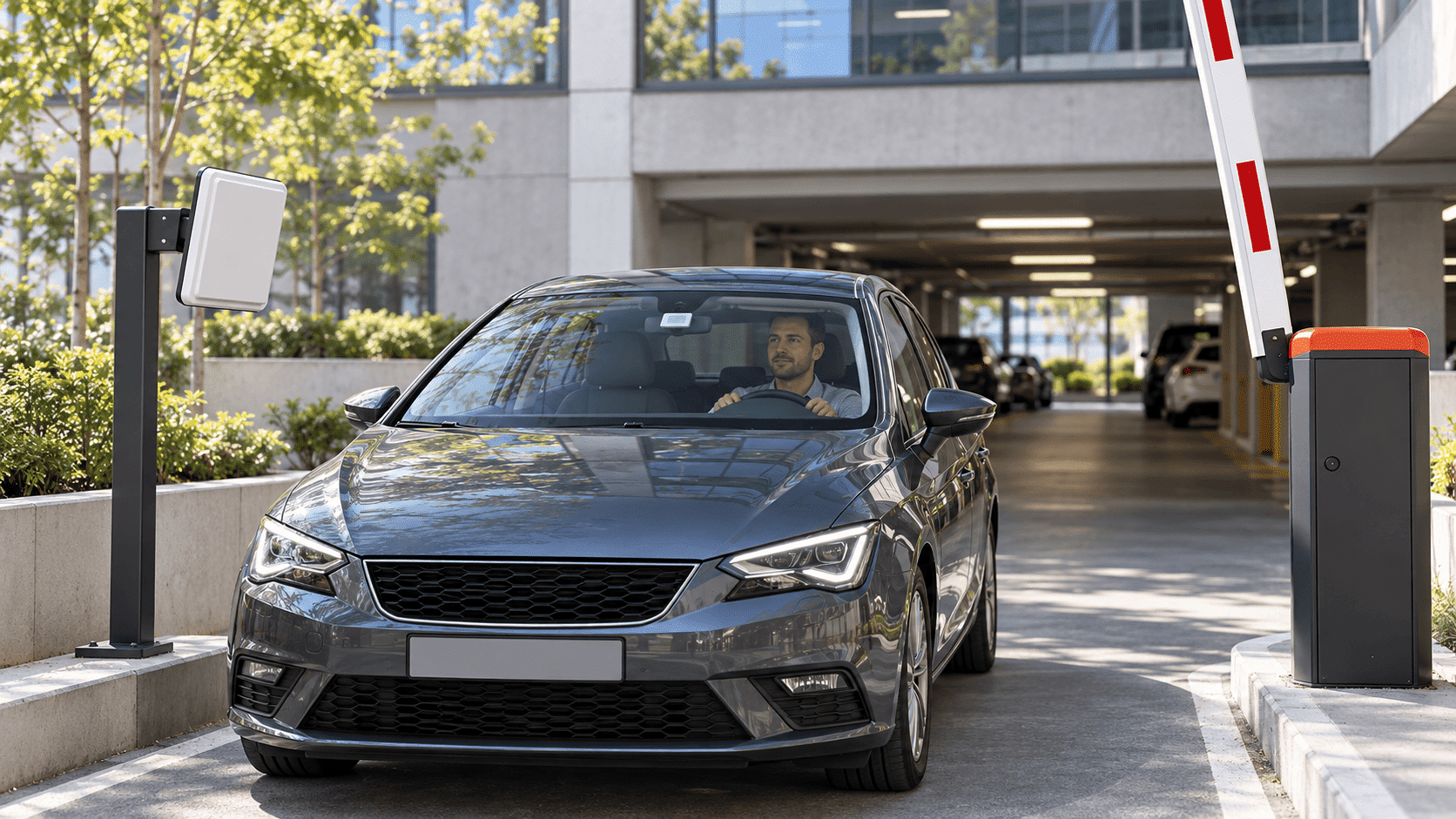
RFID technology (Radio Frequency Identification) makes it possible to automatically recognise an object, a vehicle or a person by means of radio waves, without physical contact and without a direct line of sight between the tag and the reader. It originated in military and logistics settings, but today it is one of the most widespread technologies in access control: it opens car park barriers, office doors and venue turnstiles in milliseconds, even in the rain, at night or with the vehicle in motion. Understanding how it works, which types exist and what its limits are is key to choosing the right access solution for a facility.
What Is RFID Technology and How Does It Work?
An RFID system consists of three elements: a tag or label (a microchip attached to an antenna), a reader with its own antenna, and software that interprets the information and decides what to do with it. In access control, the whole process boils down to four steps:
Emission. The reader continuously generates an electromagnetic field at a specific frequency around the access point.
Activation. When the tag enters that field, its antenna picks up the energy (in passive tags, this is their only power source) and wakes the chip.
Response. The chip sends its unique identifier back to the reader and, in some cases, additional encrypted data.
Validation. The software checks that identifier against the database of authorised users (schedules, zones, season passes, blacklists) and, if everything matches, orders the barrier or door to open.
It all happens in a fraction of a second, and the user does not have to hold anything up to anything. That is the big difference compared with barcodes or QR codes: no line of sight is needed, and the reader can identify the tag through plastic, glass or dirt.
RFID Types by Frequency
The operating frequency determines the read range, the speed and the type of application. Three main bands coexist in access control:
Band
Frequency
Typical range
Common use in access control
LF (low frequency)
125–134 kHz
Up to 10 cm
Classic proximity cards and key fobs for doors and time clocking. A veteran technology: inexpensive, but with weak security.
HF (high frequency)
13,56 MHz
Up to 10 cm
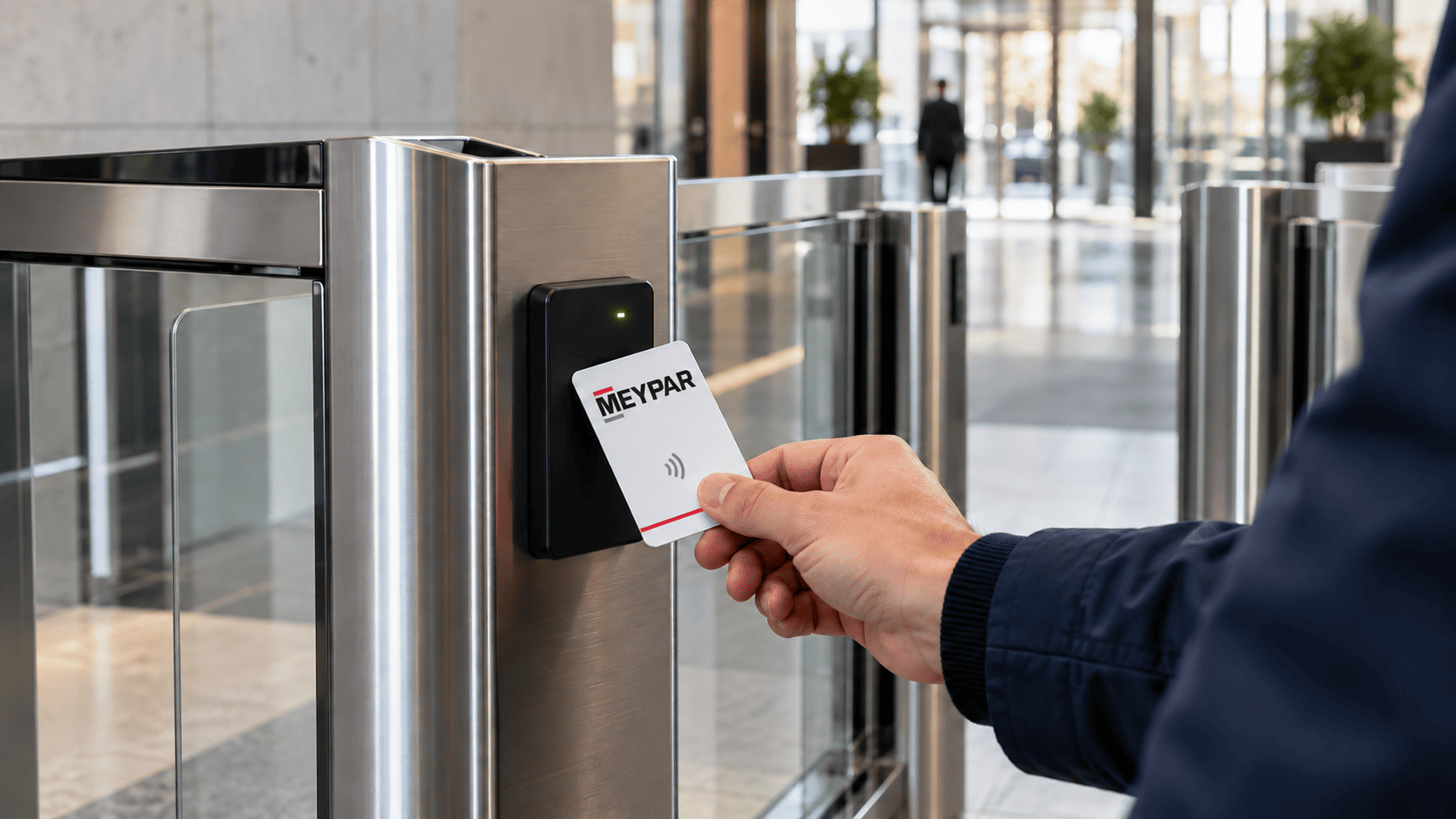
Smart cards (ISO/IEC 14443 and 15693 standards, MIFARE family) and phone NFC. Supports encryption and is the benchmark for pedestrian access.
UHF (ultra-high frequency)
865–868 MHz in Europe
Several metres (up to about 10 m with passive tags)
Long-distance vehicle identification: windscreen or headlight labels that open the barrier without the driver having to stop. EPC Gen2 / ISO/IEC 18000-63 standard.
The rule of thumb is simple: the closer the read, the more control; the longer the range, the smoother the flow. That is why pedestrian doors usually work in HF, where the user deliberately brings the card up to the reader, while vehicle access has shifted towards long-range UHF.
Passive and Active Tags: A Key Distinction
Besides frequency, tags differ in how they obtain their energy:
Tag type
How does it work?
Advantages
Common use
Passive
No battery. Powered by the field the reader emits.
Cheap, lightweight, maintenance-free and with a practically unlimited service life.
Cards, key fobs and adhesive windscreen labels in UHF.
Active
Has its own battery and transmits its own signal.
Longer range and more stable reading in difficult conditions.
Long-distance vehicle access, fleets and logistics areas. The battery has to be replaced every few years.
In most car parks, the passive UHF tag has become the norm: it offers several metres of range, costs little per unit and requires no maintenance. Active tags are reserved for cases where distance or the environment justify them.
Why Is It Increasingly Used in Access Control?
RFID is not a new technology, but several factors have accelerated its adoption over the past decade, especially in vehicle access:
Hands-free access. The driver does not wind down the window, look for the card or stop. Queues at peak times disappear and the experience of season-pass holders and employees improves.
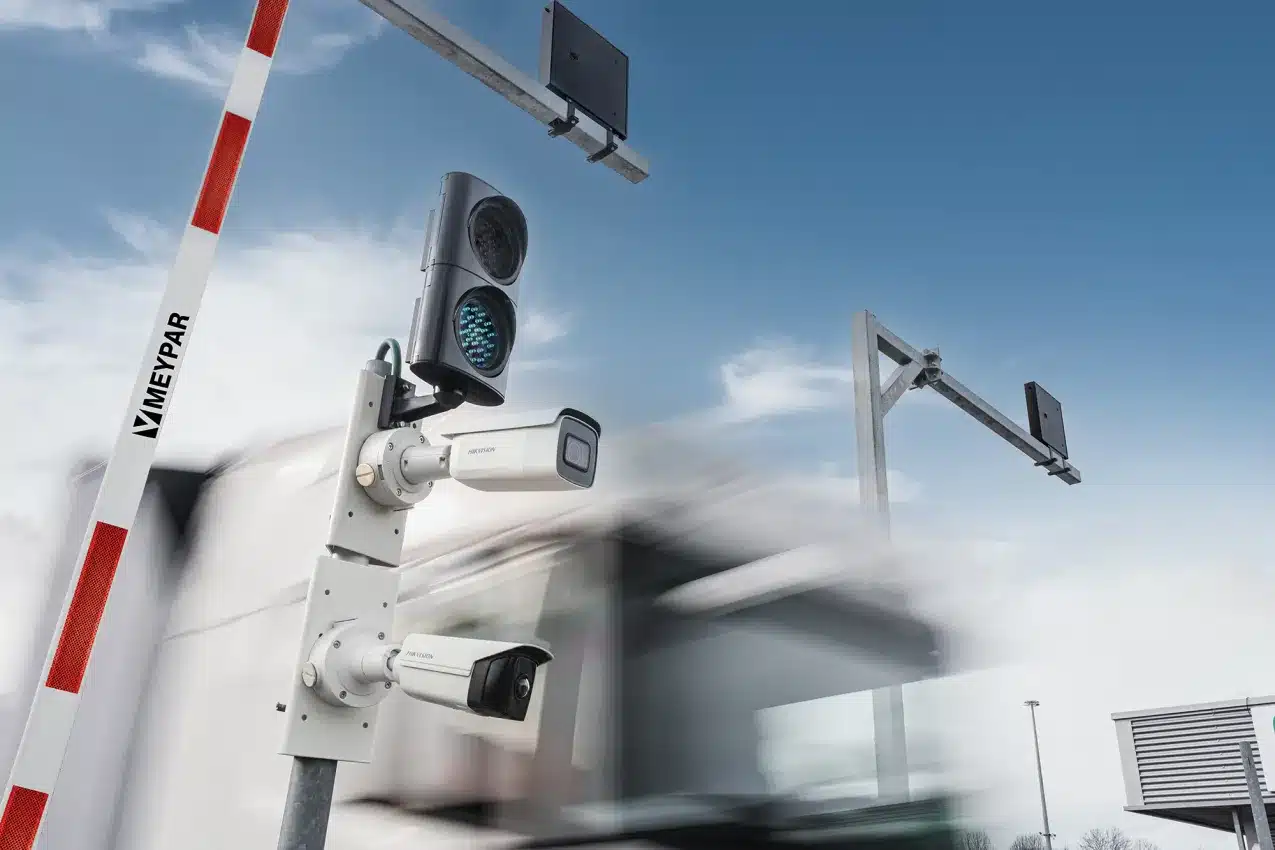
Reliability in any condition. Unlike cameras, radio-frequency reading does not depend on light, rain or fog, or on whether the number plate is dirty or hidden by a trailer.
No wear and no contact. There are no magnetic stripes to get damaged and no buttons to break. A passive tag has no moving parts and no battery.
Centralised management. Registering users, restricting schedules or cancelling a lost credential is done instantly from the software, without touching the entry equipment.
Full traceability. Every read is logged with the date, time and access point, which makes audits, season-pass billing and occupancy control easier.
Advanced functions.Anti-passback prevents the same credential from being used to enter twice without having exited, and integration with barriers, pay stations and control centres makes it possible to automate operations.
Low cost per user. Passive labels are inexpensive and durable, which makes it viable to issue credentials to hundreds or thousands of recurring users.
On top of this comes an underlying trend: the sector is moving towards ticketless facilities, where the regular user is identified automatically and paper is reserved, at most, for the occasional visitor.
RFID Compared with Other Access Technologies
RFID does not compete alone. Each technology identifies something different and has its own strengths:
Technology
What does it identify?
Strength
Weakness
UHF RFID
The credential (tag)
Long-range reading, hands-free, stable in bad weather
The tag can be moved to another vehicle if it is not tamper-proof
GDPR and AI Act requirements when processing biometric data
That is why, in demanding facilities, it is common to combine technologies: UHF RFID for the recurring season-pass holder, plate reading as a second factor or for users without a tag, and QR for visits and bookings. The management system unifies all entry routes in a single database.
Applications of RFID in Car Parks and Venues
The versatility of RFID technology means it can be adapted to very different user profiles and types of facility:
Corporate and office car parks. Employees come and go without stopping, and the facilities manager can assign spaces, zones or schedules by department.
Supermarket chain car parks. In supermarket chain car parks, RFID solves a specific challenge: keeping space turnover high for customers while giving smooth access to employees, suppliers and delivery vehicles, which may have their own permissions and time slots or direct access to the loading and unloading area.
Residential communities and complexes. Residents replace the remote control with a windscreen label that does not get lost, is not easily lent out and needs no batteries.
Hospitals. They make it possible to separate access for medical staff, the emergency department and the general public, giving priority to shifts that cannot wait.
Logistics and industrial sites. Company fleets and regular hauliers are identified from a distance, and every entry is logged for dock control and dwell times.
Season-pass holders in public car parks. Monthly customers enter as if it were their own private garage, while turnover visitors continue to use tickets, QR codes or plate reading.
Security, Privacy and Regulation
Can an RFID Tag Be Cloned?
It depends on the technology. The oldest 125 kHz LF cards transmit their identifier unencrypted and can be copied with low-cost equipment. The same is true of some generations of HF cards whose encryption is now considered vulnerable. Current credentials with AES encryption and mutual authentication between tag and reader raise the level of protection considerably.
In UHF vehicle access, the most common risk is not cloning but the tag being peeled off and moved to another car. To prevent this, tamper-proof labels are used, which are destroyed if someone tries to remove them, and RFID reading can be combined with plate reading as double validation.
What Does the Regulation Say?
A tag’s identifier, on its own, is just a number. But as soon as the system links it to an employee, a season-pass holder or a resident, it becomes personal data subject to the General Data Protection Regulation. This obliges the operator to inform the user, define the purpose and retention period of access logs, and guarantee users’ rights.
Unlike facial recognition, RFID does not process biometric data, so it does not fall under the special category in Article 9 of the GDPR or the high-risk regime of the AI Act. In addition, the European Commission published a specific recommendation on privacy in RFID applications that advises carrying out impact assessments and clearly signposting reading points. In practice, it is one of the easiest access technologies to deploy with legal safeguards.
Frequently Asked Questions
What is the difference between RFID and NFC?
NFC is a subset of high-frequency RFID (13.56 MHz) designed for very short-range communication, of a few centimetres. It is the technology phones use to pay or to act as an access credential. All NFC is RFID, but not all RFID is NFC.
How far can an RFID reader read?
It depends on the frequency and the type of tag. With LF and HF, a few centimetres. With passive UHF, several metres, which makes it possible to identify a vehicle before it reaches the barrier. With active tags, the distance can be even greater.
Does RFID work in rain, snow or at night?
Yes. Radio-frequency reading does not depend on light or visibility, so it stays reliable in conditions where a camera may fail. Only metal objects or some heat-reflective windscreens can attenuate the signal, which is solved by placing the tag correctly.
Can the same tag be used in several vehicles?
If it is a tamper-proof adhesive tag, no: it is destroyed when you try to peel it off. If a space needs to be shared between several cars, removable tags or solutions based on combining tag and plate are available.
Is there an RFID solution designed specifically for car parks?
Yes. Solutions such as the Meypar long-range TAG identify the vehicle from a distance and open the barrier automatically, without the driver having to stop or take out a card.
Facial recognition is a biometric technology that identifies a person by analysing the unique features of their face and comparing them against a reference database, all within fractions of a second. Its use in access control (including security in shopping centres and their car parks) is growing rapidly, but it comes with a demanding regulatory […]
On April 21 and 22, Meypar Peru will be present at the 23rd International Retail Congress, one of the most relevant forums in the retail sector in Latin America, organized by Seminarium Peru. The event will take place at The Westin Lima Hotel and will bring together executives, managers, and professionals from operations, technology, marketing, […]
To provide the best experiences, we use technologies such as cookies to store and/or access device information. Consenting to these technologies will allow us to process data such as browsing behavior or unique identifiers on this site. Not consenting to or withdrawing consent may negatively affect certain features and functions.
Functional
Always active
Storage or technical access is strictly necessary for the legitimate purpose of enabling the use of a specific service explicitly requested by the subscriber or user, or for the sole purpose of carrying out the transmission of a communication over an electronic communications network.
Preferences
El almacenamiento o acceso técnico es necesario para la finalidad legítima de almacenar preferencias no solicitadas por el abonado o usuario.
Statistics
Storage or technical access that is used exclusively for statistical purposes.El almacenamiento o acceso técnico que se utiliza exclusivamente con fines estadísticos anónimos. Sin un requerimiento, el cumplimiento voluntario por parte de tu proveedor de servicios de Internet, o los registros adicionales de un tercero, la información almacenada o recuperada sólo para este propósito no se puede utilizar para identificarte.
Marketing
Technical storage or access is necessary to create user profiles for the purpose of targeting advertising, or to track the user across a website or across multiple websites for similar marketing purposes.